Void Arcade game library
Product lead AI content pipeline Live platform

Void Arcade

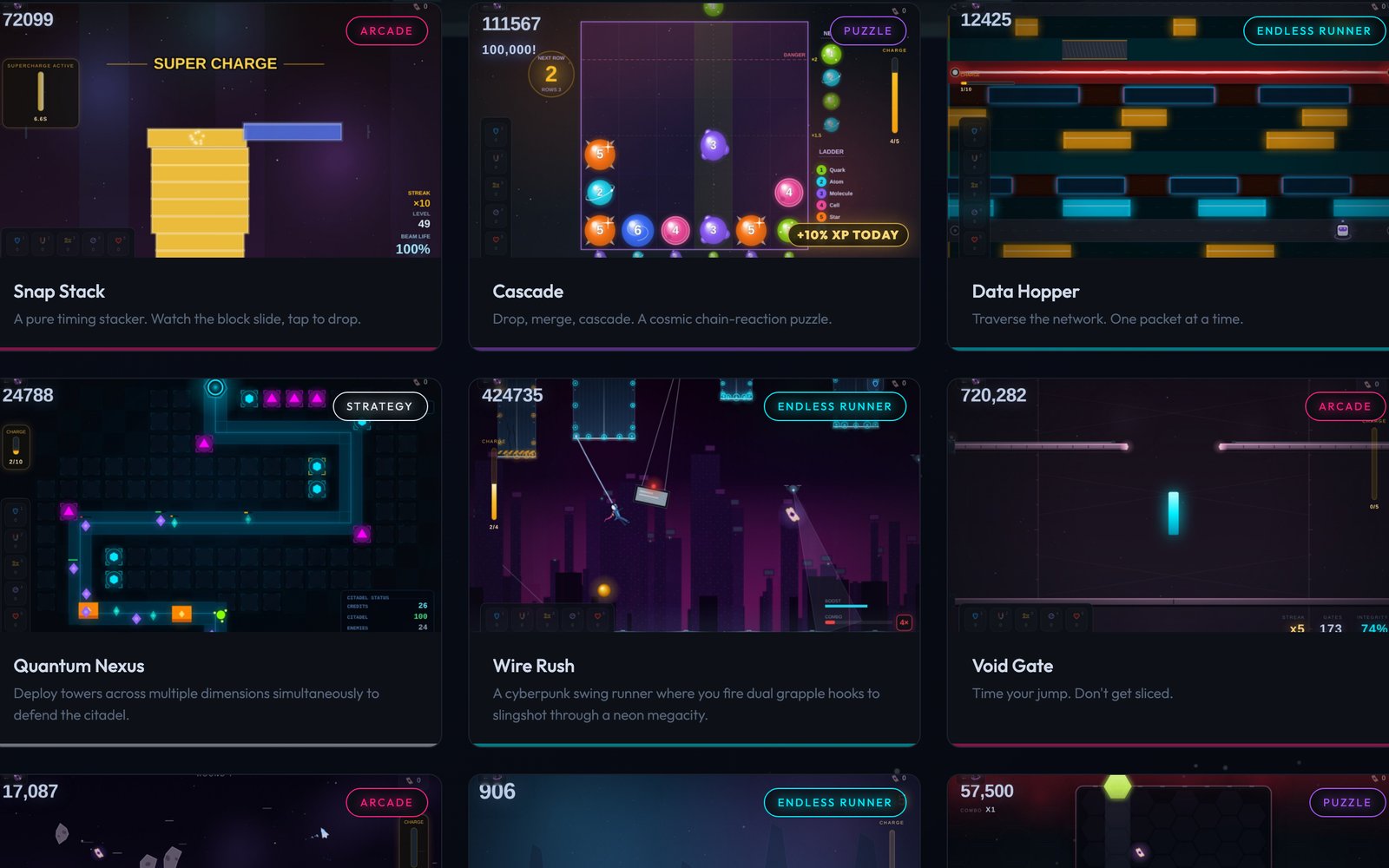
A live browser arcade at voidarcade.com, where I lead product. AI builds each new game in about two hours, and every draft has to pass quality gates before players see it.

Role

Product lead

Live since

Spring 2026

Platform

Web browser

Model

Free to play, Void Pass subscription

TL;DR

Problem

An arcade lives on new games and fast fixes. Building and tuning each game by hand does not scale.

My Role

Product lead. I designed the platform, own the roadmap, pricing, and monetization, and approve what ships.

Constraints

Every AI-generated game passes human review before release. Younger players use the platform, so social features need real moderation.

Impact

20 games in six months, each about two hours from idea to live. One retune lifted Vault Run completion from 43% to 76%.

Context and my role

Void Arcade launched in spring 2026. Players get 20 browser games, accounts with levels and badges, weekly leaderboards, and a vote on every game.

Players spend tokens to play and earn tickets for every run, then spend tickets in a shop on power-ups and cosmetics. Tickets can also be bought, but every one can be earned by playing.

The Void Pass is the season pass, billed through Stripe in two tiers: Voyager and Interstellar. Season 1, Mercury, is a story campaign with challenges and a 20-tier reward track.

I designed the platform and lead product. Roadmap, pricing, and monetization are my calls. The platform was designed to evolve on its own, so it now needs only part-time maintenance from me. That was the goal from the start.
The problem and the evidence

A small arcade needs a steady flow of new games, and every live game needs tuning. Done by hand, both mean manual work on each game, one at a time.

That cost grows with every title, and it is not sustainable.

The bet

Bet one: AI can build a new game in hours if it works inside strict modular templates and every draft faces the same quality gates.

Bet two: simulated players can find a difficulty problem before real players quit over it.

Bet three: the season pass works for one big game in Destiny and Fortnite. It can work across many small games if every run feeds one reward system.

Success measure: time from idea to live game, the share of drafts that pass review, whether real runs match the simulated curve, and pass uptake.

Options and trade-offs

Speed vs. quality gates

A game takes about 60 minutes to generate and another 60 to iterate and polish. Every draft is checked for quality, fun, template fit, and meaningful use of the power-ups. 25 drafts failed and never shipped.

Freedom vs. templates

Every game runs on shared modules for physics, interaction rules, UI, animation, and sound. That limits how far a new game can stray, and it keeps one change from turning into 20.

One big game vs. many small ones

A season pass usually rewards play in one game. Here every run, in any game, earns toward the same season track. The Interstellar tier renews monthly and adds 750 tickets a week, 2-day early access to new games, exclusive cosmetics, full season-tier rewards, and badges.

Pay vs. play

Players can buy tickets with real money, or earn all of them by playing. Only pass-exclusive items need the Void Pass.

Social features vs. safety: the chat room

I cut live chat. Social spaces are hard to moderate, and younger players use the platform. Social returns in a later season as a space station where players can interact more meaningfully, with smarter moderation for spammers, trolls, and people who could cause harm.

AI proposals vs. the final call

AI drafts a weekly list of changes from player feedback and votes. I prioritize and approve it, so nothing ships on the model's say-so.

What shipped

The Void Pass: Voyager and Interstellar tiers and what Interstellar includes
Season 1 reward track, with pass-only rewards on the second row

Results

~2 hrs
Idea to live game
25
Drafts rejected at the gate
43% → 76%
Vault Run completion after one retune

Vault Run is the clearest case of the balance check. Real players' runs fell short of the simulated ones, which pointed to a difficulty bottleneck. We retuned the difficulty and level design. Completion rose from 43% to 76%, and fewer players quit.

Every game reports the same signals: run length, scores, and death, quit, and retry rates. That is what a proposed change is argued against.

Per-game telemetry: median run, scores, and death, quit, and retry rates

The template system grew from 10 modular steps to 20. Updating one game now works exactly like updating all 20.

What I'd do differently

Break the modules up further, and sooner. We started with 10 steps and now have 20.

The goal is that a platform-level change lives in one JavaScript file and updates every game at once. Manual work on each game does not scale, and the system should never need it.